
Justice for Zadarious Dorsey: Family Demands Answers After 18-Year-Old Fatally Shot by Newnan Police Officer

NEWNAN, GEORGIA — November 6, 2026 — The family of 18-year-old Zadarious Dorsey is demanding answers and accountability following his fatal shooting by a Newnan Police Department officer during a foot pursuit on October 3, 2026.
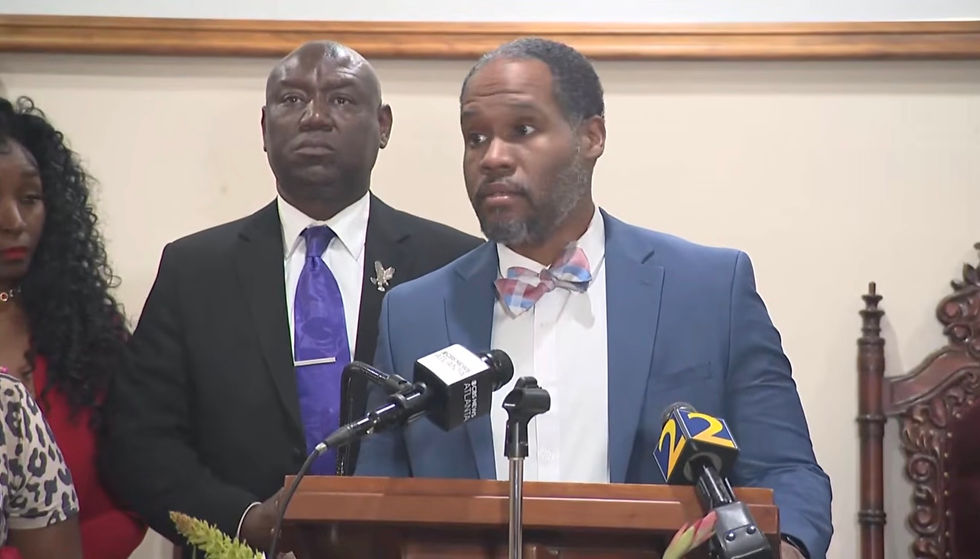
Nationally recognized civil rights attorney Ben Crump joined attorneys Harry M. Daniels and Gerald Griggs in representing the family as serious questions remain about the circumstances surrounding the shooting, the use of deadly force, and whether Dorsey's constitutional rights were violated.
At the center of this case is a critical question: Was deadly force legally justified against an 18-year-old who, according to his family's attorneys, was unarmed at the moment he was shot?
What Happened to Zadarious Dorsey?
According to the Georgia Bureau of Investigation (GBI), a Newnan police officer observed a white vehicle near Dodson Street and Martin Luther King Jr. Drive at approximately 1 a.m. on October 3. The officer followed the vehicle until it stopped on Cliff Circle.
Investigators reported that five men exited the vehicle and four fled. The officer pursued Dorsey on foot, reportedly deployed a Taser without success, and subsequently fired multiple gunshots.
The officer told investigators that Dorsey pulled a firearm from his waistband and failed to comply with commands to drop the weapon.
However, Dorsey's family and legal team dispute critical portions of that account, maintaining that he was unarmed when the officer used deadly force.
The family also questions why Dorsey was pursued when, according to their attorneys, he was not suspected of committing a crime and was not the subject of a traffic stop.
A Gun Found 42 Feet Away Raises Serious Questions
One of the most significant issues in this case involves the location of a firearm recovered following the shooting.
According to information released by the Coweta Judicial Circuit District Attorney's Office, investigators recovered a Canik 9mm handgun with an extended magazine approximately 42 feet from where Dorsey fell. Authorities also reported finding Dorsey's DNA on the weapon.
The presence of DNA on a firearm does not, by itself, establish whether someone was holding that weapon at the precise moment an officer fired.
The family's legal team maintains that Dorsey had discarded the firearm before being shot.
The critical questions are when the firearm was discarded, what the officer could reasonably perceive, and whether Dorsey posed an immediate threat when deadly force was used.
These are questions that must be answered through a thorough and transparent investigation.
Body-Camera Footage Could Be Critical Evidence
The officer involved in the shooting was equipped with a body-worn camera.
The Coweta County District Attorney's Office has confirmed that the family was given an opportunity to review the footage and frame-by-frame images. Prosecutors have indicated that the recording will be released publicly following the completion of the GBI investigation.
The video evidence could help establish the sequence of events, including the officer's commands, the location of the firearm, Dorsey's movements, and the timing of the gunshots.
Transparency is essential when a police officer takes a life. The public deserves a complete and accurate accounting of what happened, and the family deserves answers supported by the evidence.

The Constitution Places Limits on Police Use of Deadly Force
The Fourth Amendment to the United States Constitution protects individuals against unreasonable seizures, including excessive force by law enforcement officers.
In Tennessee v. Garner, 471 U.S. 1 (1985), the United States Supreme Court established that police cannot use deadly force against a fleeing person merely to prevent escape. Deadly force must satisfy constitutional requirements, including those concerning a significant threat of death or serious physical injury.
In Graham v. Connor, 490 U.S. 386 (1989), the Supreme Court explained that excessive force claims must be evaluated under an objective reasonableness standard, considering the facts and circumstances confronting the officer.
These constitutional protections are central to the questions raised by Dorsey's death.
The fact that a person runs from police does not automatically justify deadly force. Likewise, the discovery of a firearm does not end the constitutional inquiry into whether shooting that person was reasonable.
The specific circumstances, including the timing of any perceived threat, must be carefully examined.
The Family Continues Its Fight for Justice
The Georgia Bureau of Investigation is conducting an independent investigation at the request of the Newnan Police Department. Once completed, its findings are expected to be submitted to the Coweta Judicial Circuit District Attorney's Office for review.
Any criminal determination regarding the officer's actions is separate from the potential civil rights claims available to Dorsey's family.
For the family, this case is about more than an investigation. It is about the loss of an 18-year-old whose life mattered and the demand for accountability when law enforcement uses deadly force.
Attorneys Ben Crump, Harry M. Daniels, and Gerald Griggs are working alongside the family to seek answers, examine the evidence, and pursue justice.
No family should have to bury an 18-year-old without receiving a full and transparent explanation of the circumstances surrounding his death.
Civil Rights Attorneys Address the Shooting in Newnan
The family and its legal team scheduled a news conference for Friday, November 6, 2026, at noon at the Chapel of Roscoe Jenkins Funeral Home, located at 182 Millard Farmer Industrial Boulevard in Newnan, Georgia.
The news conference was announced to provide a major update regarding the case and the family's continuing pursuit of justice.
As the investigation moves forward, Attorney Gerald Griggs remains committed to fighting for constitutional rights, police accountability, and justice for families impacted by the use of deadly force.
Justice demands transparency. Accountability demands answers. And the fight for Zadarious Dorsey continues.
Attorney Gerald Griggs is an Atlanta-based criminal defense and civil rights attorney and former President of the Georgia NAACP. Known as the JUSTICEFIGHTER, Griggs advocates for constitutional rights, police accountability, and equal justice under the law.


Comments